

Try to envision Mljet as a wonderful Island in the world of ISO 50001? An enchanted world�?
Summertime is coming� picture the island of Mljet� as a peaceful spot on the Adriatic Sea� with its coves and woods� and the constant cicada chirping. Reassuring you that the weather is warm and calm, and that you should take things slow.
If you have not yet visited Mljet, I strongly recommend that you do so, very soon. It is one of the most southern islands of Croatia. Located in the deep segment of Adriatic Sea, where intensive turquoise shades of sea water dominate over the blue ones.
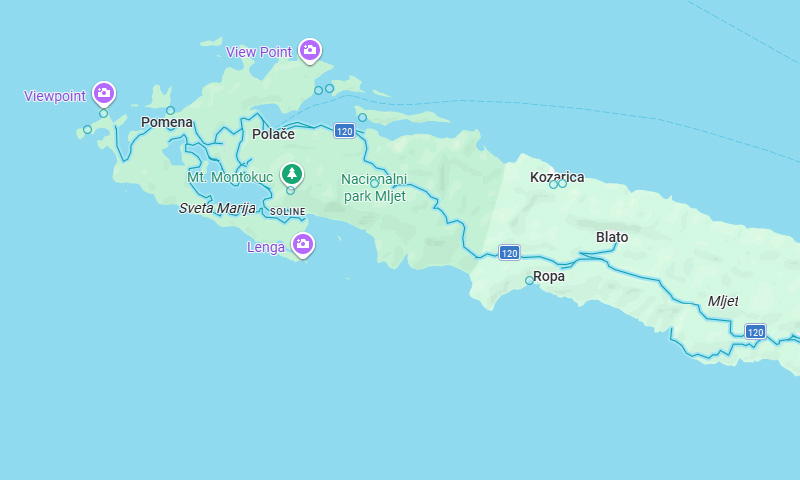
The first time I went to Mljet was in early 1980s. The island was made public for the first time to the rest of the nation. Until then, it was a military zone with restricted access. Everything was green. There was only a short, asphalted road form the ferry port to the hotel. All the other roads were macadam.
Even today, the hotel is in the National Park Mljet that consists of nearly 5,300 hectares of land and sea. It was established in 1960. Two saltwater lakes with an island on the lake, are surrounded by forests. The island of Mljet is known as the "island of forests" and is one of the most forested and greenest Croatian islands.
Allow me to take you on a stroll through Mljet.
The Mljet ecosystem works on a principle most organisations have not yet adopted: every resource has a purpose; every unit of consumption has a reason.
The Island of Sveta Marija (Otok Sveta Marija) is an island on the salt lake on the island itself. The monastery on it has stood since the 12th century. It is the structure that contains everything. Without this particular island, none of the structures would exist.If you would imagine the whole Island of Mljet as an ISO 50001 Energy Management System primary framework applicable to any organisation wanting to apply the EMS to, then the Island of Sveta Marija (Otok Sveta Marija) could be the boundary of your choosing, for its implementation. The ISO 50001:2018 (Energy Management Systems): Sets requirements for energy policy, planning, implementation and improvement.
On the island of Mljet lives the Sivi sokol / Peregrine Falcon (Falco peregrinus). The peregrine is a bird of prey (raptor) in the family Falconidae known for its speed. A large, crow-sized falcon, it has a blue-grey back, barred white underparts and a black head. The falcon sees the whole island from above before it acts. It maps territory, identifies where energy flows, finds the weak points. An energy audit as described in ISO 50002:2014 (Energy Audits) does exactly this: it surveys the entire organisation from above before any action is taken. No other bird covers ground faster or with more precision. The audit is the falcon's pass over the system.
In the salty waters of the surrounding Adriatic Sea, lives a special shell. The Plemenita periska / Noble Pen Shell (Pinna nobilis) is a large species of Mediterranean clam, a marine bivalve mollusc in the family Pinnidae, the pen shells. It reaches up to 120 cm of shell length. The largest bivalve in the Adriatic. Strictly protected by law. It lives anchored to the seafloor, filter-feeding only what passes through it, rejecting what does not meet its standard. As described in the ISO 50003:2014 (Certification Requirements), the certification body does the same: it filters claims of compliance, accepts only what is verifiable, and is itself protected by strict legal and normative requirements. It cannot be moved. It cannot be bypassed.
In the forests on the island of Mljet dominates Alepski bor / Aleppo Pine (Pinus halepensis). It does not grow fast, but it does provide a lovely shade form the sun. It grows persistently, across rocky karst terrain where other species give up. Its root system adapts to whatever substrate it finds. Similarly, ISO 50004:2014 (Implementation & Improvement) is the implementation guide: it does not promise quick results. It provides the methodology for establishing, adapting, and improving the EMS system over time, on whatever organisational terrain you start from.
While the constant cicada chirping in the Alepski bor / Aleppo Pine (Pinus halepensis) branches rarely ceases during summer months, in the bottom of the truncks lives Obicni puh / European Edible Dormouse (Glis glis). The dormouse measures everything by biological clock precision: it knows exactly when to eat, when to store, when to sleep, and when to wake. Its survival depends on reading internal indicators correctly. It�s behaviour mimicks the ISO 50006:2014 (Energy Performance Indicators). Energy performance indicators (EnPIs) and baselines work the same way: they tell an organisation whether it is consuming more or less than its reference point, and whether the trend is moving in the right direction. The dormouse does not guess. It measures.
On the other hand, in the treetop�s lives Crvendac / European Robin (Erithacus rubecula). The robin is one of the most present birds in Mljet's pine forests and maquis. It does not dominate. It accompanies. It sings at dusk and dawn, orienting other species to the rhythm of the day. Energy services described under ISO 50007:2017 (Energy Services) work the same way: they do not impose, they accompany users, assessing what energy services they actually need and improving the delivery of those services. The robin does not consume the forest. It helps other species navigate it.
Under the salt sea water lives Jakobova kapica / Scallop (Pecten jacobaeus). The scallop has two distinct shells, one convex and one flat, joined by a hinge. It moves by opening and closing, measuring the pressure difference between inside and outside to propel itself. Quite similar in nature to the ISO 50015:2014 (Measurement & Verification). This standard describes measurement and verification within the EMS. How to compare what was predicted against what actually happened, using the difference to drive the next action. The scallop is also the symbol of the pilgrim: proof of a completed journey. ISO 50015 is the proof that the energy savings claimed were real.
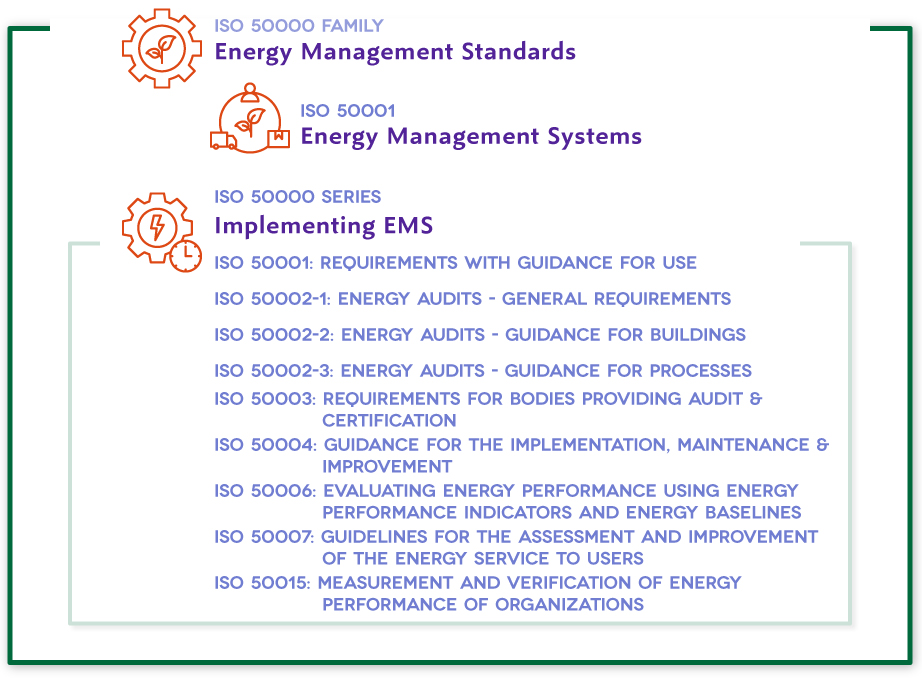 ISO 50000 family stadards
Net.studio Aranea Ltd. author of graphic
ISO 50000 family stadards
Net.studio Aranea Ltd. author of graphic
Now think about your company. You know what you pay for energy in euros. But do you know which process consumes the most? Do you know if that consumption is necessary for your business model? Most CEOs and CFOs I work with do not. That is not negligence. It is a systemic problem that is growing in importance in 2026 year of geopolitical shifts.
Every company today is playing the same game against three opponents.
The first is regulation. The Energy Efficiency Act NN 155/2025 is not a recommendation. Article 29 sets a clear obligation for defined categories of companies. The deadline is not abstract. Penalties are not symbolic.
The second opponent is the market. Clients, especially those in the supply chains of larger European companies, increasingly require proof of energy compliance as a precondition for working together. Banks and funds financing green investments require verification of savings. CSRD reporting requires data most companies do not have.
The third opponent is internal inertia. The energy bill arrives every month. You pay it. Move on. But where those kilowatt-hours were consumed, which process used them, and whether that consumption was necessary, this is rarely asked. Companies have the data. They lack the methodology and time to connect it.
As I wrote previously about how the ISO 14000 family of standards changed the approach to environmental management, the ISO 50000 family is now doing the same for energy management. The difference is that the regulatory context in Croatia is no longer theoretical.
Article 29 of the Energy Efficiency Act NN 155/2025 is not something you will resolve ad hoc before an inspection. If your annual energy mix consumes more than 23,61 GWh, your company requires an energy audit, a measurement and verification system, and documented methodology.
Three options are in front of you:
- � Check your annual energy mix. Does the consumption of all your energy sources needed for your business exceed 23.61 GWh?
- � Start implementing ISO 50001 and build a sustainable energy management infrastructure that serves CSRD, EU Taxonomy and future regulations.
- � Wait for the letter from the State Inspectorate and the Ministry of Economy, and react then, with more costs and less time.
Companies that build this infrastructure now move through future compliance cycles with significantly less friction. Those that wait pay twice: the financial penalty and the cost of rapid adaptation.
If you want to discuss where your organisation stands in relation to Article 29 and what the fastest path to compliance looks like, get in touch. No generic answers. Just analysis specific to your business model.